SEO case study · Brand migration · Qm Uniforms → Galls
Fold in the brand. Keep every product it ranked for.
Galls and Qm Uniforms sold the same kinds of gear to the same public safety customers, from two separate websites. I led the project that folded qmuniforms.com into galls.com: one site, one checkout, and thousands of product pages that had to arrive with their search rankings intact.
- Client
- Galls (in-house)
- Role
- Project lead
- Scope
- Brand consolidation · Domain migration · Product redirects · Category alignment · On-page signal retention
-
10K+
product pages migrated
-
1:1
product-to-product redirects
-
6
on-page signals carried over per product
-
2 → 1
brands, sites and checkouts
Before and after
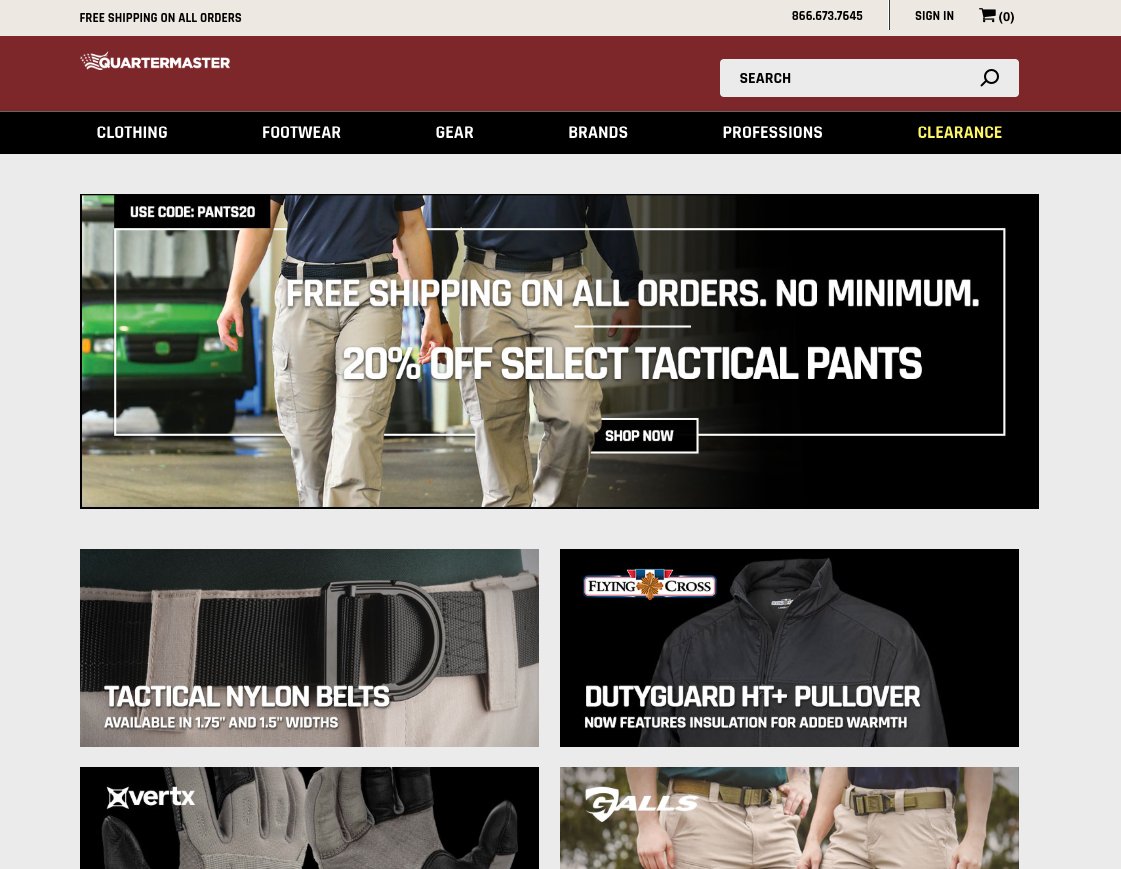
Before · qmuniforms.com
After · galls.com
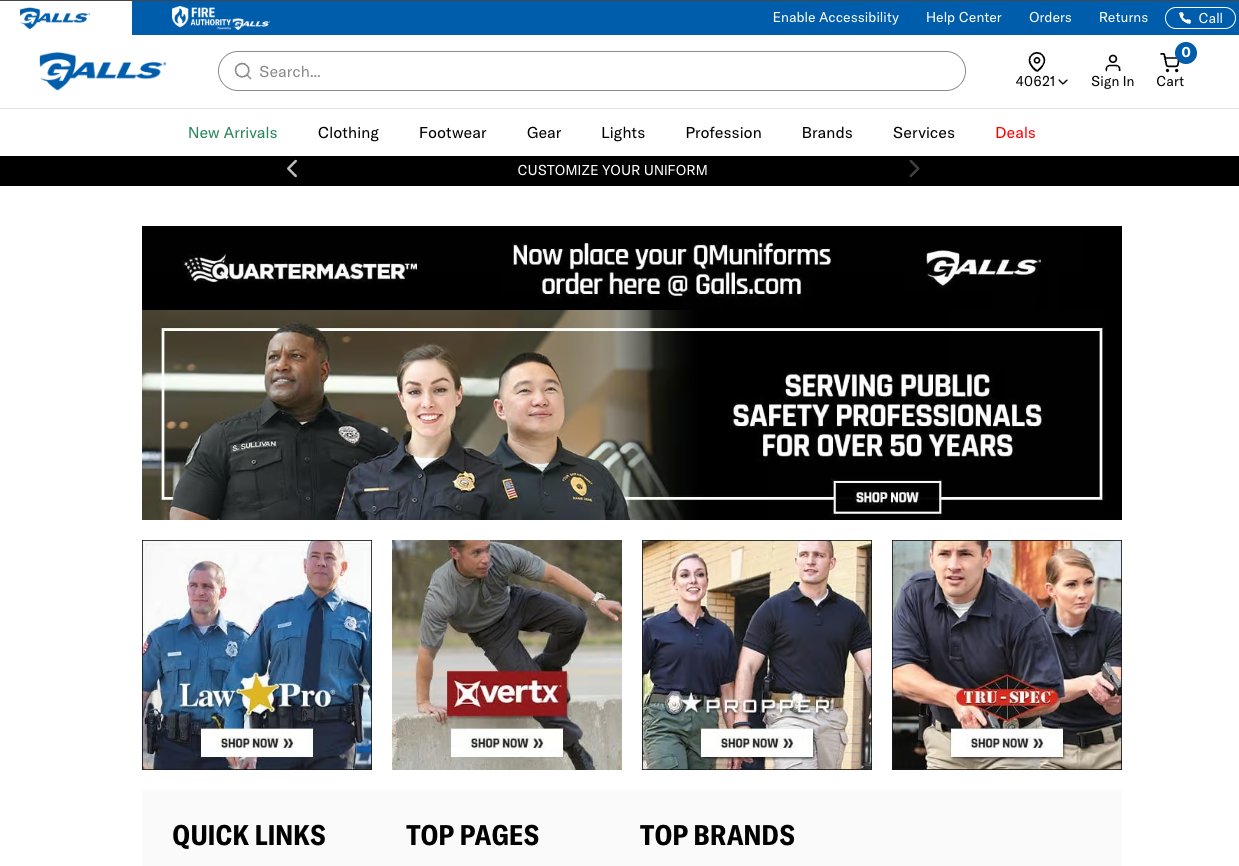
The Quartermaster homepage, and Galls after the move, telling Qm customers where to order now. Tap to enlarge.
Part 1
Plan
Know every product on the old site, find its twin on the new one, and make the two catalogs speak the same language.
01 · The situation
Two storefronts. One company.
Galls and Quartermaster, the company behind Qm Uniforms, merged in 2012. Both sold uniforms, duty gear and footwear to police, fire, EMS and security professionals. Many of the same brands were on both sites.
Running two ecommerce sites for one company meant two catalogs to keep up to date, two checkouts, and two sites competing for the same searches. The decision was to fold Qm Uniforms into galls.com.
02 · The problem
Retire the site. Keep what it earned.
In ecommerce, most search traffic lands on product and category pages, not the homepage. A migration that handled the homepage well and the product pages badly would lose most of what qmuniforms.com had built. Three things had to make the move:
Product pages
Thousands of Qm product pages ranked for specific items. Each one needed a new page that deserved those rankings.
Categories
Qm’s category pages ranked for broad searches like tactical pants and duty belts. They needed matching Galls categories to hand that off to.
The name
Customers had searched for Qm and Quartermaster for decades. That habit wasn’t going away on launch day.
03 · The product inventory
Every product, matched.
The work started with a complete inventory of qmuniforms.com: more than 10,000 product pages, plus every category page.
Then each Qm product was matched to the same product on galls.com. The two sites named their URLs differently, but every product had a unique SKU, the item number that stays the same whichever site sells it. Matching on SKU turned more than 10,000 product URLs into an exact 1:1 map: no guessing, and no product left without a destination.
04 · Category alignment
Same aisles. Same signs.
Category pages are the aisles of an online store. They rank for the broad searches (tactical pants, duty boots, flashlights) that products alone don’t win.
Each Qm category was mapped to its Galls equivalent, so the rankings Qm’s category pages had earned for those broad searches carried over to the Galls page covering the same products.
Part 2
Build
Point every old URL at the right new page, make sure that page carries the same signals, and give the old name a place to land.
05 · Product redirects
One product, one new address.
A redirect sends anyone who visits an old URL, person or search engine, to its new one. A permanent (301) redirect also passes along most of the ranking value the old page had earned.
Every Qm product redirected 1:1 to the same product on galls.com. Not to the homepage, and not to a generic category page. Someone searching for a specific pair of pants found that pair of pants, and Google saw the new page as the old page’s rightful replacement.
Category pages redirected to their aligned Galls categories, so the broad searches followed too.
The shortcut
Send everything to the homepage. Google treats it as a lost page, and the rankings go with it.
The 1:1 approach
Product to product, category to category. Every old URL landed on the page that matched it.
06 · On-page signals
Move the page, not just the URL.
A redirect points Google to the new page. What it finds there decides whether the rankings stick. If the new page describes the product differently, Google has to reconsider it from scratch.
So for every migrated product, the Galls page had to carry the same on-page signals the Qm page had earned its rankings with:
- Title tagsThe page title search engines show as the headline.
- Meta descriptionsThe short summary under that headline.
- H1sThe main heading on the page.
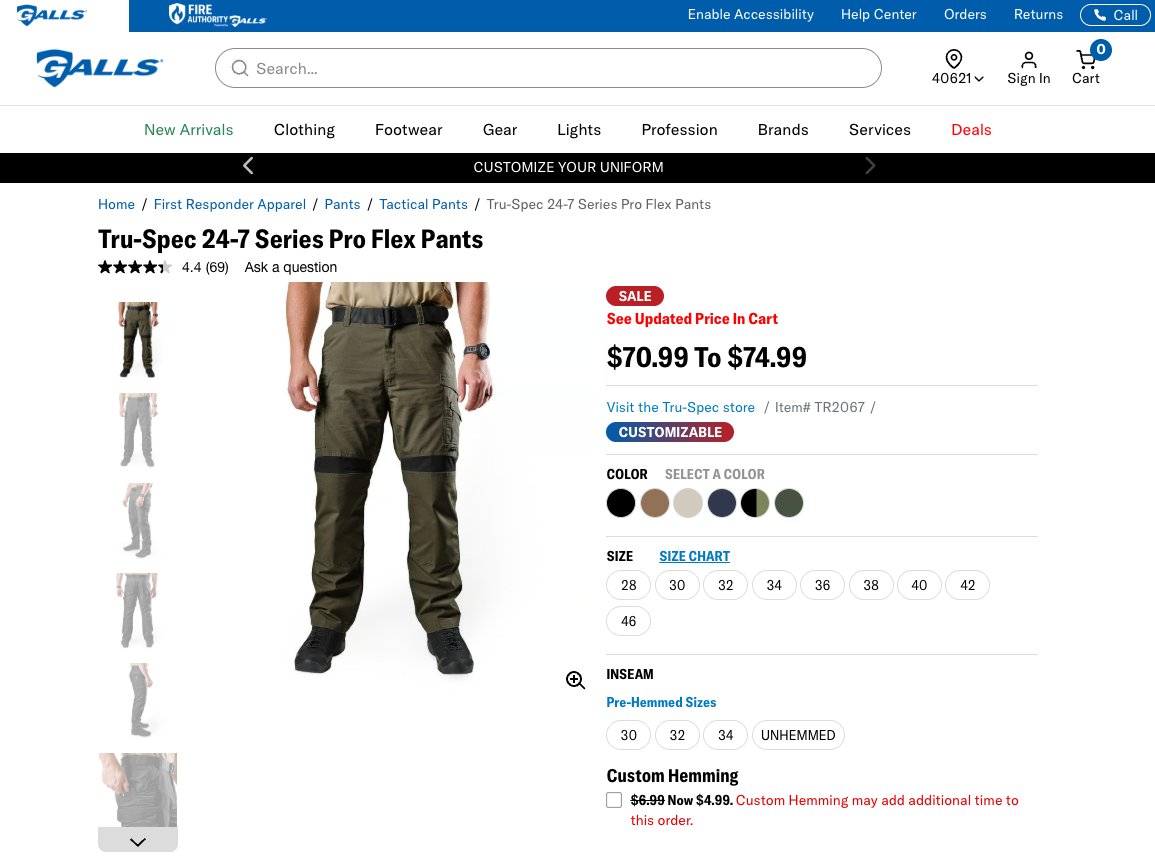
- Product copyDescriptions, features and specs.
- Product schemaCode that tells search engines the price, availability and ratings.
- Image alt textDescriptions of product photos, for screen readers and image search.
07 · A home for the old name
You can retire a site. Not a search habit.
Redirects cover old links and bookmarks. They don’t cover people typing “Quartermaster uniforms” into a search bar next month.
A Quartermaster brand page on galls.com gave those searches somewhere relevant to land, and gave Qm’s own products a home on the new site. On the homepage, a banner told returning Qm customers plainly where to order now.
08 · QA
Check the map before anyone uses it.
Before launch, the redirect map was tested against the old URL list: every old URL had to redirect once, straight to a live page, with no chains and no dead ends.
The destination pages were checked against the old ones for the six signals above, so no product arrived on galls.com missing the title, copy or schema that had earned its rankings.
Part 3
Launch
Turn the redirects on, and watch what Google does with them.
09 · Moving day
Flip the switch. Watch everything.
At launch, the redirects went live and the old URLs were checked on the live site. From there, the job was watching crawl errors and traffic, and fixing any old URL that landed somewhere it shouldn’t, as soon as it turned up.
10 · Learnings
What I’d keep, and what I’d change.
- 1
Match on the SKU, not the URL
The two sites named their URLs differently, so matching by URL would have failed. A unique SKU on every product is what made an exact 1:1 map possible at this scale.
- 2
Products and categories are separate jobs
Product redirects protect rankings for specific items. Category alignment protects the broad searches. A migration that handles one and not the other loses half its traffic.
- 3
Give the old name somewhere to go
Redirects handle old links. A brand page and a clear message on the homepage handle the people still searching for the old name.
Related SEO case study
Aramark → Vestis: rebranding without the brand.
Another brand going away: a content matrix, 40 non-branded content pieces and nearly 350 local pages.
Read the case study →
Related SEO case study
Wasabi: a new site that keeps the old traffic.
A WordPress to Storyblok replatform and rebrand, built on a content catalogue and a keep, kill or repurpose decision for every page.
Read the case study →
Merging stores? Bring the rankings with you.
Folding one ecommerce site into another is thousands of small decisions. Let’s talk about making them before launch, not after the traffic drops.